If you’re a long-time Mac user or someone who picks up secondhand Apple hardware for repairs or retro projects, you’ve probably run into a wide range of weird, discontinued ports over the years. From the bulky SCSI ports of 90s Macs to the short-lived MagSafe 2 connector, Apple has never shied away from swapping out connectivity options to fit its design goals. One of the more common legacy ports you’ll find on mid-2000s Macs is Mini DVI, a compact alternative to full-size DVI that filled a specific niche for a few short years. If you’ve ever asked when was mini dvi introduced in Mac world, this guide breaks down its full history, supported devices, and how you can still use it today.
When Was Mini DVI Introduced in Mac World? Exact Launch Details
Mini DVI made its first official appearance at the 2006 Macworld Conference & Expo in San Francisco, during Steve Jobs’ legendary keynote that kicked off Apple’s shift to Intel processors. The port was announced as part of Apple's transition from PowerPC to Intel processors, a major shift that let Macs run Windows natively for the first time. Before that, Apple relied on Mini-VGA ports for its consumer laptops and all-in-one desktops, but that port couldn’t keep up with the higher resolution displays the new Intel-powered Macs were capable of driving.
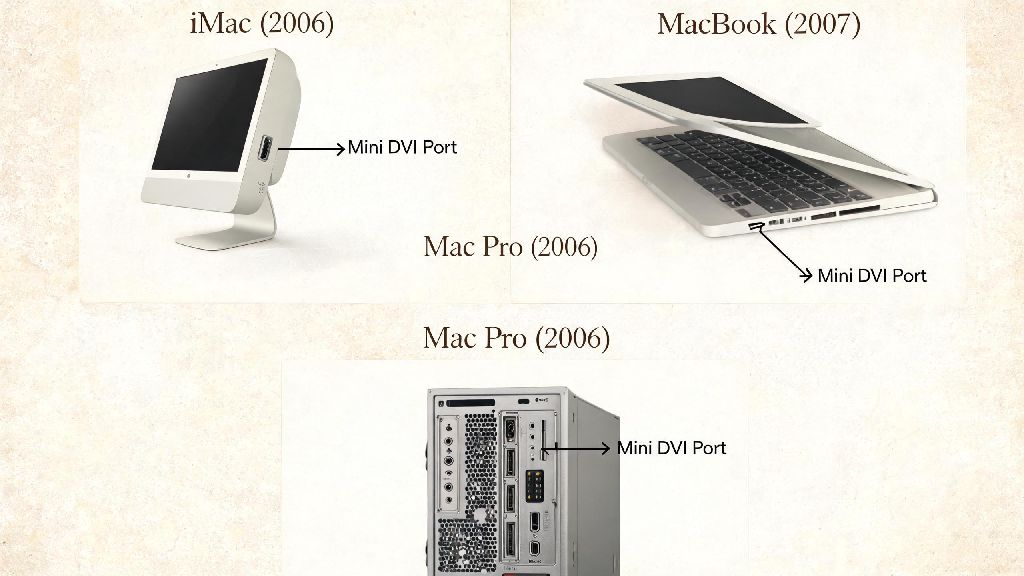
The first devices to ship with Mini DVI were the 2006 Intel iMac line, available in 17, 20, and 24-inch sizes, followed quickly by the final revision of the 12-inch PowerBook G4 a few months later. I remember heading to my local Apple reseller’s launch event that January, and being frustrated at first that my old Mini-VGA adapter for my 2004 iBook wouldn’t work with the new iMac. The sales rep explained that the new port could handle the 23-inch Apple Cinema Display’s 1920x1200 resolution, which my old iBook couldn’t even come close to pushing, so the swap made sense for power users. It didn’t take long for Mini DVI to roll out across Apple’s entire consumer line, showing up on the first polycarbonate MacBooks and even the ultra-thin first-generation MacBook Air that Jobs pulled out of a manila envelope in 2008.
Core Reasons Apple Rolled Out Mini DVI for Its Product Line
Apple didn’t just swap ports for fun, even if it feels that way sometimes. There were three specific, practical reasons the company moved to Mini DVI in 2006. First, the old Mini-VGA port had a hard limit of 1080p resolution, which was already falling behind industry standards for professional and consumer displays. Mini DVI, by contrast, could push up to 1920x1200 at 60Hz, which matched the maximum resolution of Apple’s top-of-the-line Cinema Displays at the time.
At the time, the smaller port size cut nearly 2mm off the thickness of the MacBook line, a big selling point for users who prioritized portability. Full-size DVI ports were bulky, and taking up that extra space would have made the new Intel MacBooks thicker than the PowerPC models they replaced, which would have been a bad look for a launch that was supposed to showcase Apple’s innovation. Third, Mini DVI was compatible with nearly all existing display standards without requiring expensive active adapters. Unlike later proprietary ports, you could pick up a $10 passive adapter to connect a Mini DVI Mac to VGA, DVI, or even HDMI displays, as long as you didn’t need audio carried over the same cable.
That said, Mini DVI had a pretty big flaw that frustrated a lot of users: it didn’t support audio passthrough. If you wanted to connect your MacBook to a TV to watch a movie, you needed a separate 3.5mm audio cable running from your headphone jack to the TV’s audio input, which meant extra cords and more clutter. Mini DVI supported both analog and digital display signals, so it worked with old VGA monitors and new DVI or HDMI displays with a cheap passive adapter, something that newer fully digital ports can’t always do without extra hardware.
Which Mac Models Came Equipped With Mini DVI Ports?
Mini DVI only had a three-year lifespan, so it only showed up on a specific range of Mac models released between 2006 and 2009. It’s easy to mix it up with later ports like Mini DisplayPort or Micro DVI, so knowing which models had it can save you a lot of headache when you’re shopping for adapters. The full list of Mini DVI-equipped Macs includes:
If you have a Mac from that era but aren’t sure if it has Mini DVI, there’s a simple way to check. If you're unsure what port your old Mac has, Mini DVI is slightly wider than a USB-A port and has a flat edge on one side, unlike Mini DisplayPort which has a slanted edge. You can also look up your Mac’s model number on Apple’s support site to confirm the port layout, but a quick visual check is usually enough. Apple phased out Mini DVI starting in late 2008, when it introduced Mini DisplayPort across its product line. Mini DisplayPort was even smaller, supported higher resolutions, and could carry audio and video over the same cable, making it a much more versatile option for most users.
Practical Tips for Using a Mini DVI Equipped Mac Today
Even though Mini DVI has been discontinued for more than 15 years, there are still millions of these old Macs in use around the world, whether as retro gaming machines, media servers, or basic word processing devices for kids or students. If you have one of these devices, you don’t have to shell out for a new computer just to connect it to a modern display. First, make sure you buy the right adapter for your needs. If you’re connecting to an old VGA projector or monitor, a basic passive Mini DVI to VGA adapter will work perfectly for 1080p or lower resolutions. If you’re connecting to a modern HDMI TV or monitor, you can get a passive Mini DVI to HDMI adapter for less than $15, as long as you don’t mind running a separate audio cable.
Avoid cheap no-name adapters, as many of them have signal interference that leads to blurry displays or dropped connections. I’ve made this mistake myself, buying a $3 adapter off a discount site that would cut out every 10 minutes when I connected my old 2007 MacBook to my TV. Spending a few extra dollars on a reputable brand will save you a lot of frustration. Second, if you want to cut down on cables, look for a Mini DVI to HDMI adapter that has a built-in 3.5mm audio input. These adapters combine the video signal from the Mini DVI port and the audio signal from your Mac’s headphone jack into a single HDMI output, so you only need one cable running to your TV or monitor. They’re a bit more expensive than basic adapters, but they’re worth it if you hate dealing with tangled cords.
Third, don’t waste money on high-end adapters that claim to support 4K resolution. None of the Mini DVI-equipped Macs have graphics cards powerful enough to push 4K, so any adapter that advertises 4K support is just a marketing gimmick for these older devices. Also, never force a cable into the port if it doesn’t fit. Mini DisplayPort cables look very similar to Mini DVI, but they’re not compatible, and pushing too hard can bend the pins inside the port, which is almost impossible to repair on these old machines. I’ve seen a friend break the Mini DVI port on his old MacBook Air this way, and he had to use a wireless display adapter for the rest of the device’s life because the port was too damaged to use.
So now you know the answer to when was mini dvi introduced in Mac world, plus all the context you need to work with this quirky legacy port. It’s a small piece of Apple’s history that marked a huge transition for the company’s entire product line, and even though it’s long been replaced by smaller, more versatile ports, it still has a place for anyone who loves working with old Apple hardware. I still keep a 2007 polycarbonate MacBook in my cabin for writing and watching old movies, and my trusty Mini DVI to VGA adapter lets me connect it to the beat-up old projector I have hanging on the wall. It’s not the fastest machine around, but it works perfectly for what I need it for, and that’s the whole point of holding onto old tech. You don’t always need the newest device to get value out of it, even if it uses a port most people have never heard of.